

The dispute, five ways
One pair of briefs, read in four passes. Every view builds on the one before it, and every correction you make carries through to the gaps.
Your brief
Your position, mapped in layers
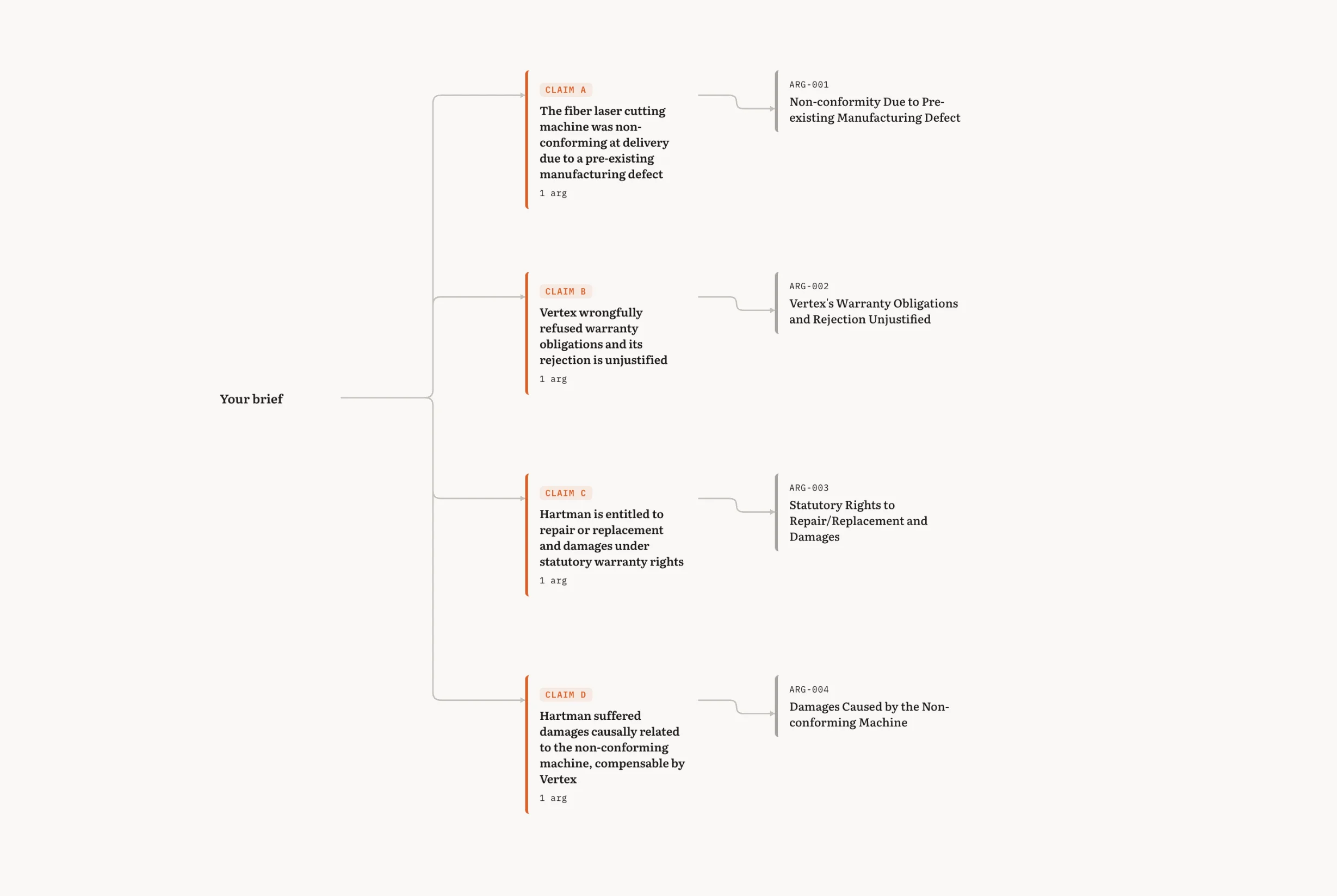
Upload your brief. Garry structures your claims, defences and legal reasoning into a visual map: the facts as you state them, the rules you rely on, and how you apply one to the other. Correct anything inline before the next step runs.
Their brief
The same structure for the other side

Upload the opposing brief. Garry maps their position with the same layers, so both sides are comparable argument for argument. Each defence gets its own node, labelled and counted, branching off the brief it came from: a warranty exclusion under article 4.2(d), contributory negligence that reduces or eliminates liability.
The match
Who responded to what
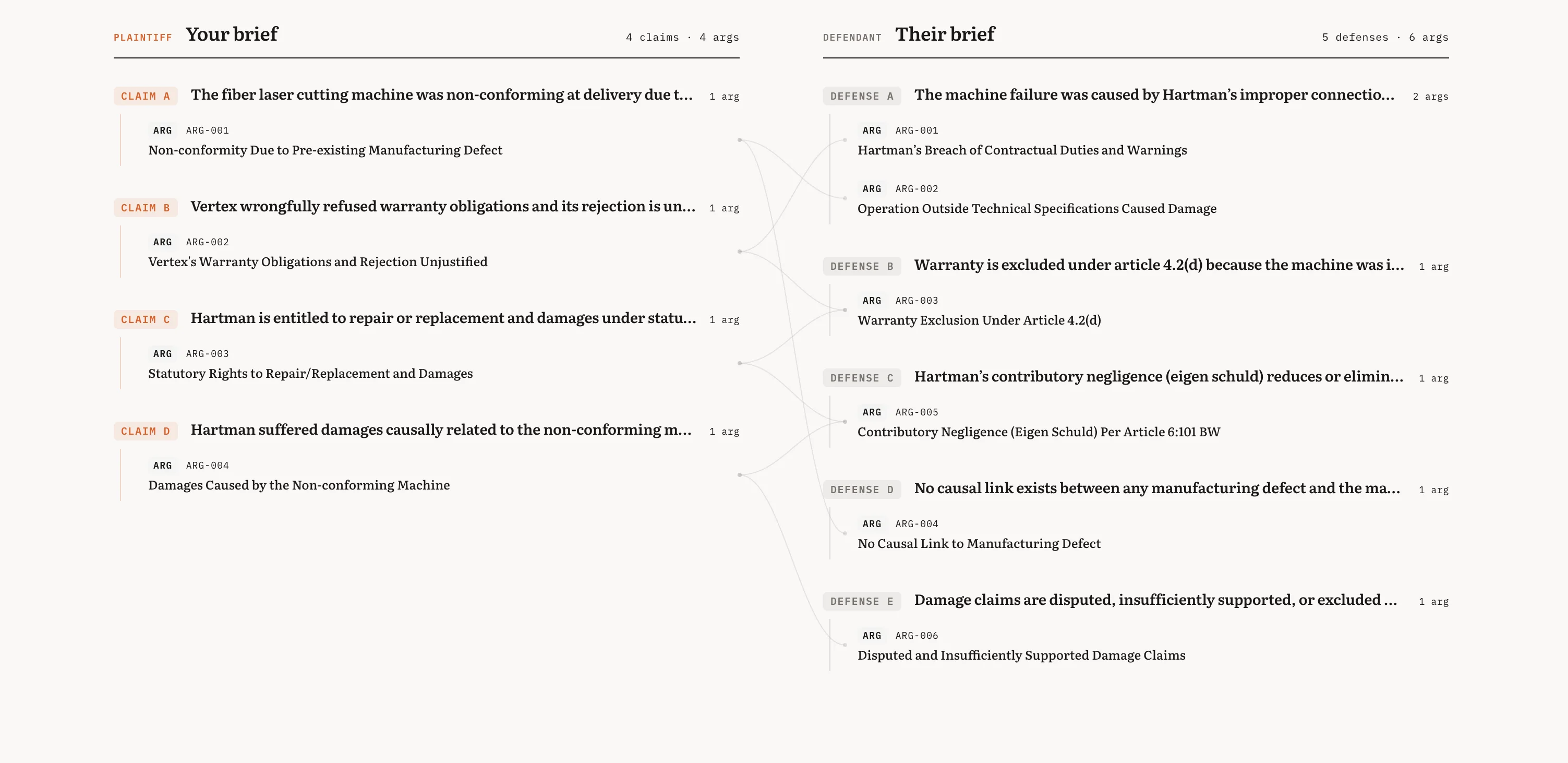
Garry overlays both maps and matches responses to claims. Each of your arguments is marked addressed, partially addressed or not addressed by the other side, and the same for theirs. Where there is a line, there is an exchange. Where there is no line, there is silence.
The gaps
What neither side has dealt with
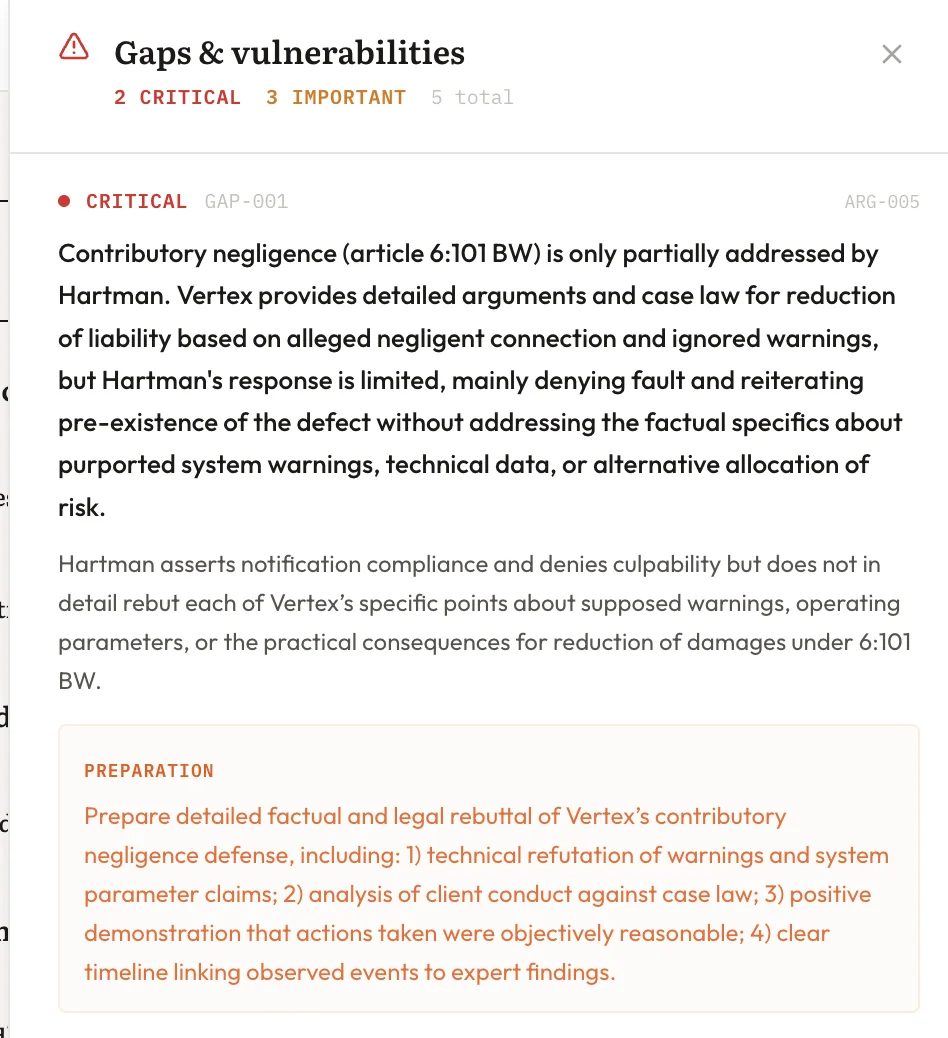
The arguments they left unanswered, the points you have not addressed, and what is still contested. Clustered by importance and by relevance to the hearing, so your preparation time goes to the gaps.
Hearing prep
The questions the court is likely to ask
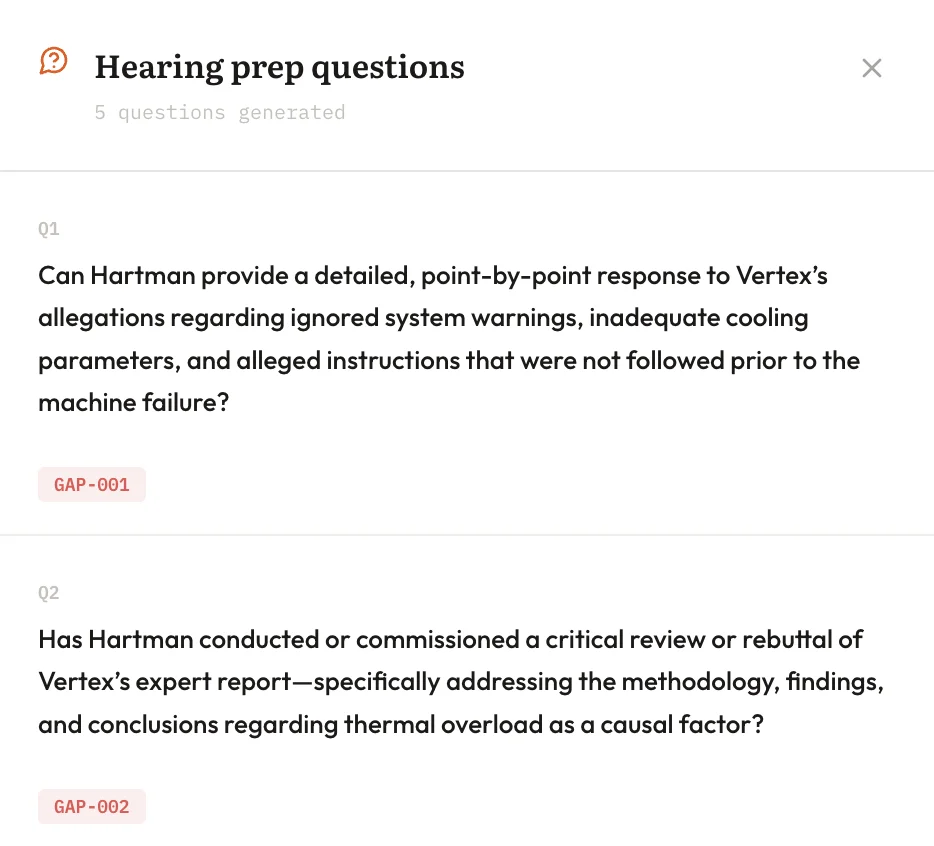
A question bank built from the gaps. Each question is tied to the specific gap that raised it, so you can prepare the answer before you walk in.
How lawyers use Garry
Two 40-page briefs and a hearing in three days.
Upload both sides. Garry maps the arguments, shows what was addressed and what was ignored, and surfaces the gaps. Seven of them you had not spotted.
Prep time goes to the gaps, and to nothing else.
An arbitration with a statement of claim, a defence and three procedural orders.
Garry maps the dispute structure across the filings and builds the question bank from the contradictions and the missing evidence.
Cross-examination questions tied to the record.
You want to know what you missed before opposing counsel finds it.
Upload your draft before filing. Garry maps your reasoning and shows where a claim is underdeveloped or a step in the chain is missing.
The gap you would have walked into, found in advance.
Facts on one side, arguments on the other
Thea reads the documents in a matter and orders what happened: the timeline, the parties, the evidence. Garry reads the briefs and orders what each side argues about it.
Both work on the same matter in Mino. Upload once and jump from a timeline event to the argument that rests on it, and back. Start with the facts or start with the law, and there is no rework in between.
15 July 2024
Notice of default sent by Bakker on behalf of Emma de Vries. Source: letter, exhibit 4.
Claimant argues the notice put the landlord in default. The defence says the notice never set a reasonable term. Response status: partially addressed.
Question for the hearing: what term did the 15 July letter set, and where does the record show it?
European infrastructure
Your briefs are processed and stored in Europe. The model Garry runs on by default is hosted in an EU data centre.
Your own AI key
Add an Anthropic, OpenAI, Azure or Mistral key and Garry analyses on it, under your own contract with the provider.
No training, ever
Your documents are not used to train AI models. We use enterprise endpoints whose terms prohibit training on customer data.
You control access
Row-level security per matter. Two-factor authentication on every account. Pseudonymised matters keep party names away from the model.
Find the gap before the hearing does.
Upload both briefs and have the argument map on screen before you read either one a second time.
Garry is included in Mino Pro.


