

A case page built for its source
A Strasbourg judgment, an advertising code decision and a construction award do not read the same way. Feitlijn gives each source its own blocks, with the one thing that matters for that kind of case on top.
Rechtspraak
Summary, timeline, IRAC, statutes
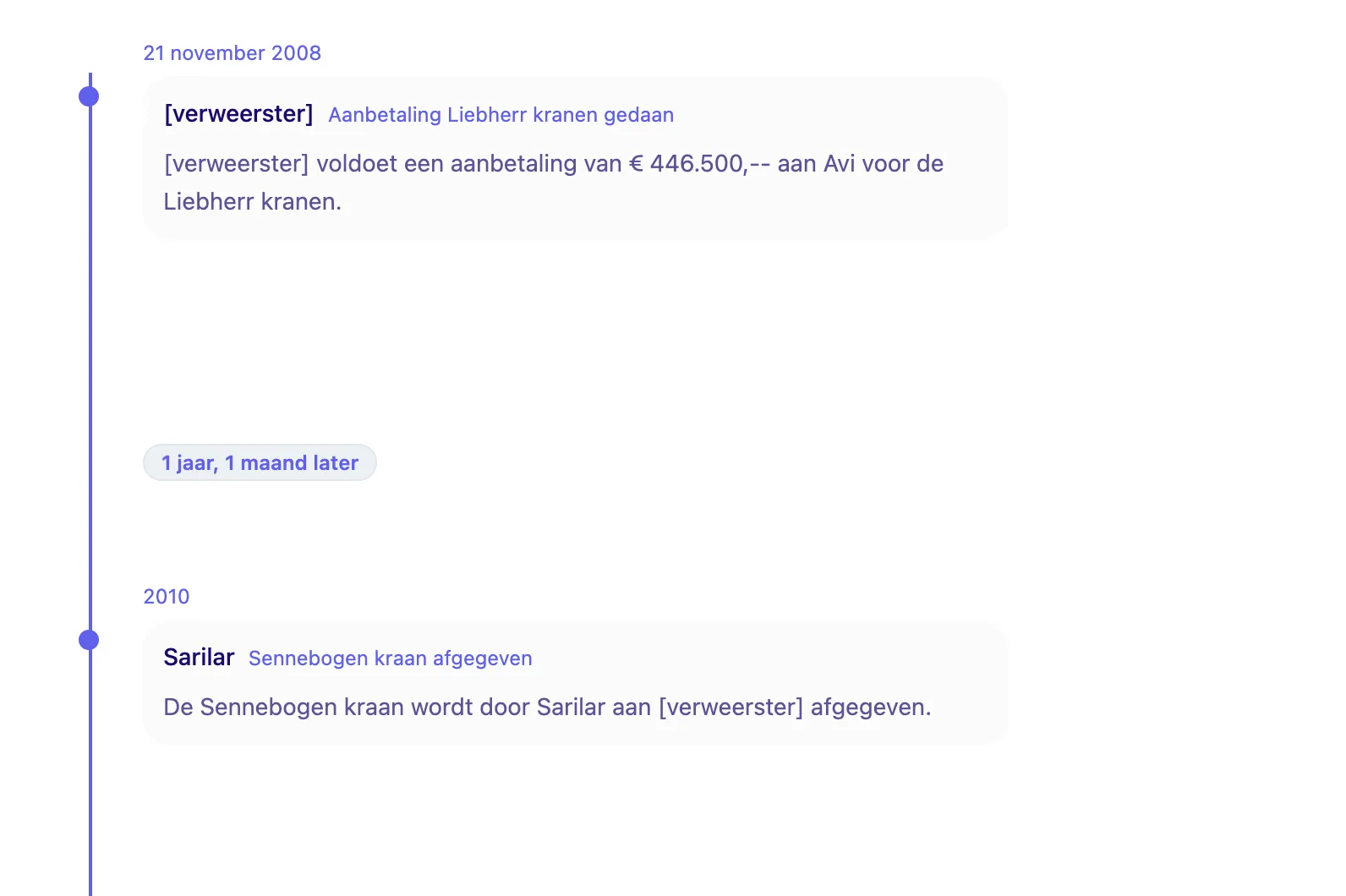
A summary (Samenvatting) with both parties' positions and the outcome. A timeline (Tijdlijn) of what happened, with the gap between events spelled out: one year and one month later. The legal analysis (Juridische analyse) in IRAC: issue, facts, application, conclusion. The statutes cited in the ruling (Wetsartikelen), enriched with the statutory text. For an Advocate General's opinion (conclusie A-G): the grounds for cassation (cassatiemiddelen) and the sources cited (bronvermeldingen) instead.
Blogs
What the profession wrote about it
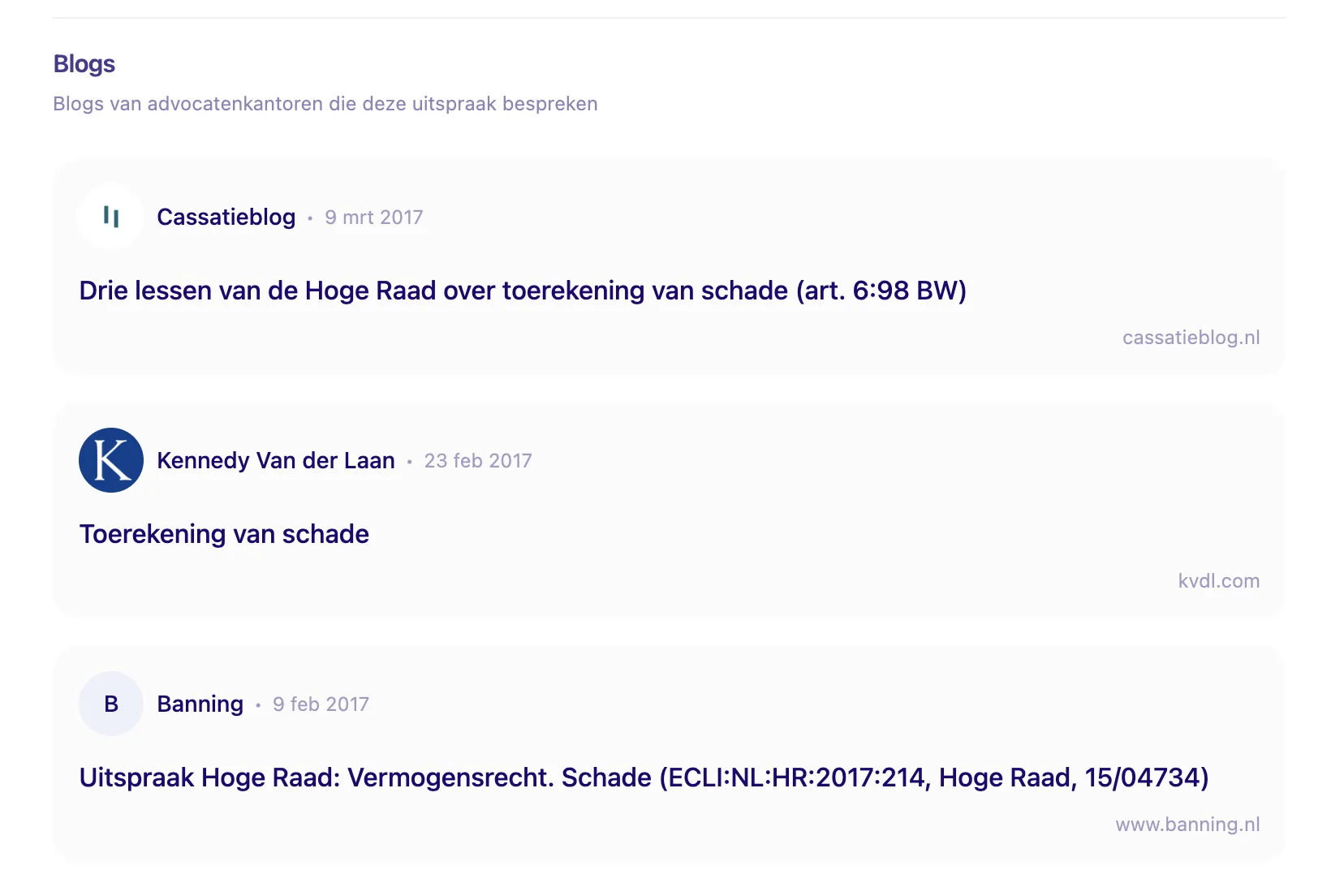
Under each ruling, the law firm blogs that discuss it, dated and linked. Three firms writing about one Supreme Court (Hoge Raad) ruling on attribution of damage is a signal in itself. The same reading Nina uses for the Friday digest.
EUR-Lex
Preliminary questions, question next to answer
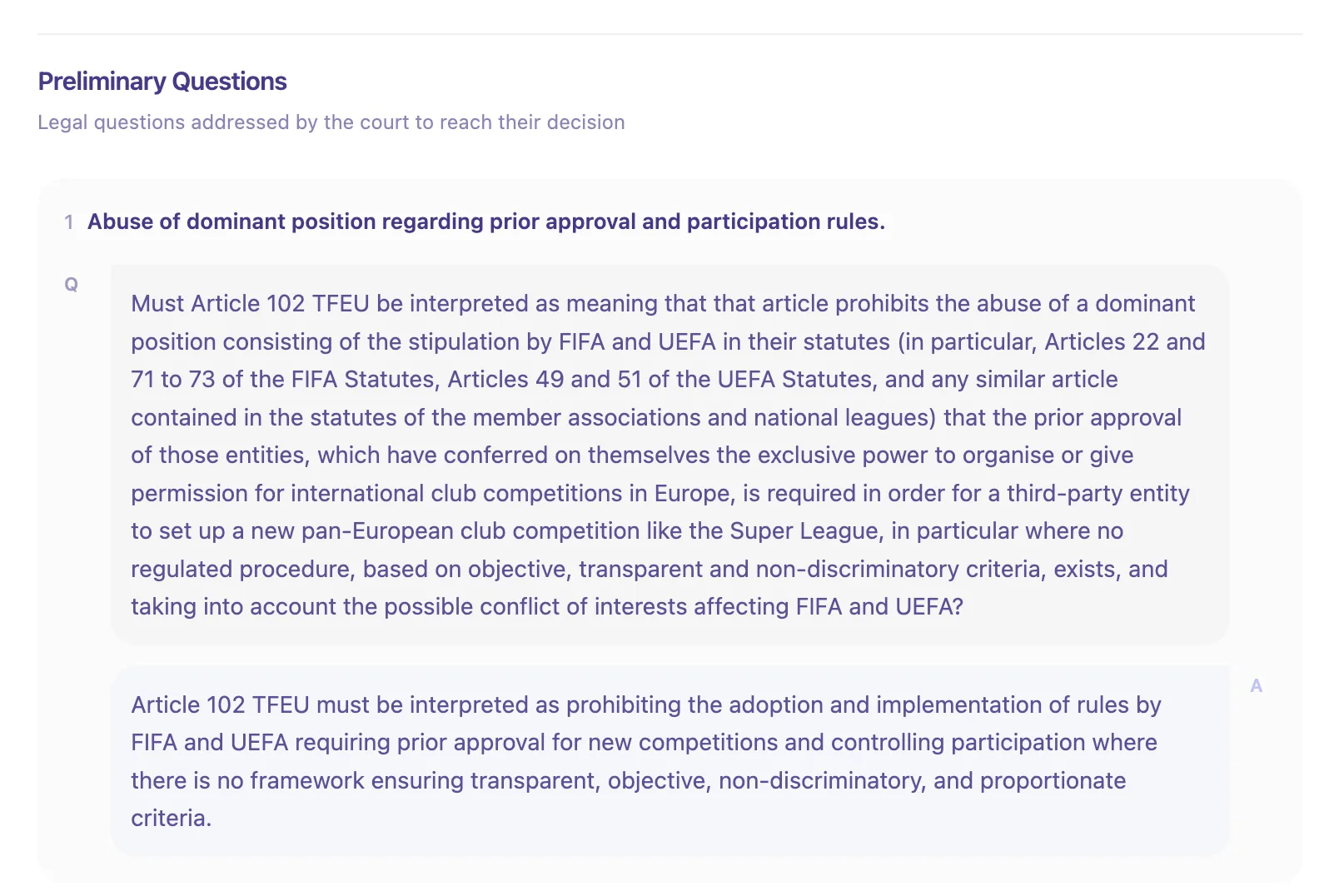
For a Court of Justice case, each question from the referring court sits next to the Court's answer to it. In the Super League case: whether Article 102 TFEU prohibits FIFA and UEFA's prior-approval rules, and the answer that it does where no transparent, objective and proportionate framework exists. Summary, timeline and IRAC analysis follow, as for a Dutch ruling. A C-number takes you straight to the case.
European Court of Human Rights
Per-article analysis
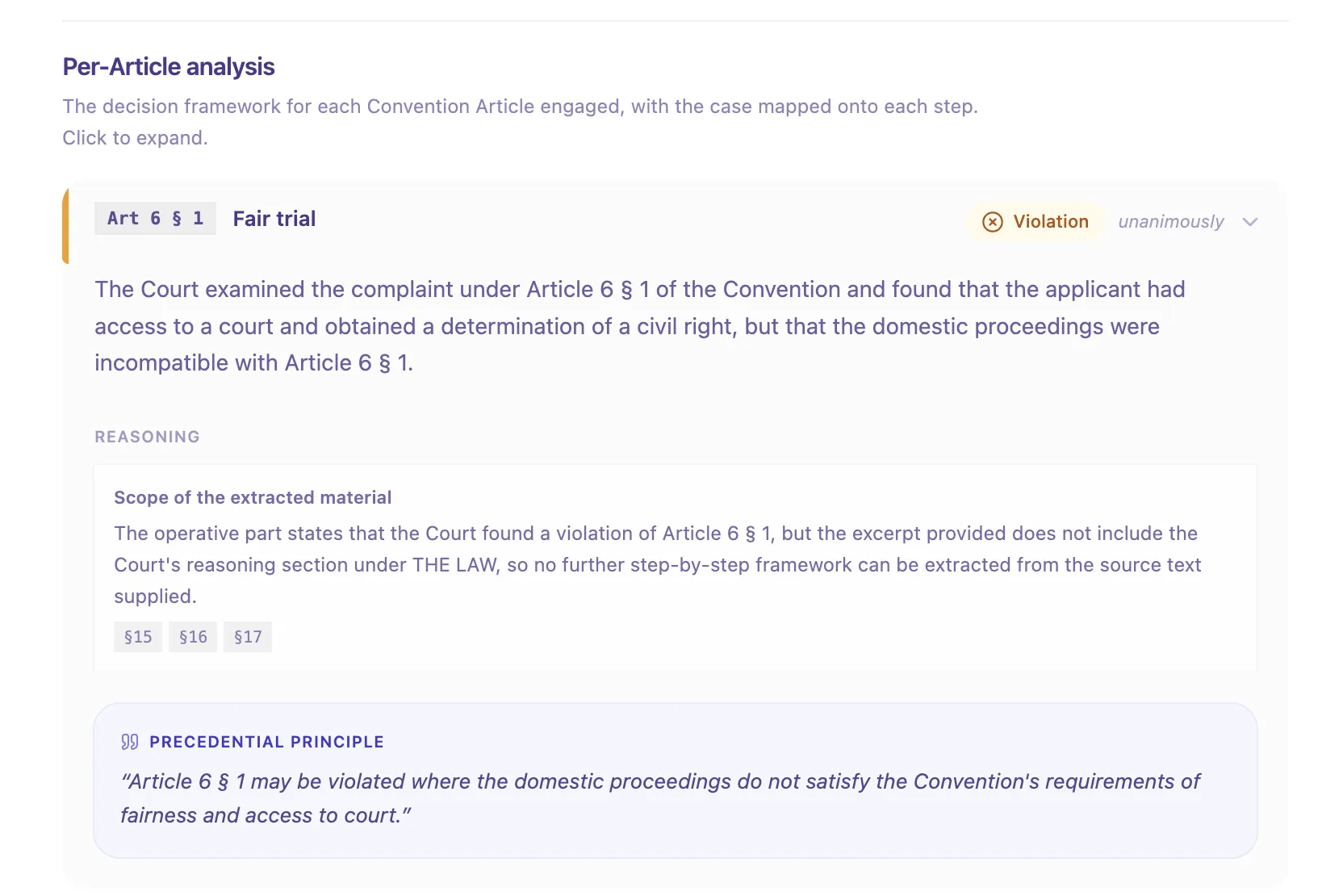
Each Convention article the case engages gets its own block: the finding, unanimously or not, the Court's reasoning mapped onto the decision framework step by step with paragraph references, and the precedential principle in one sentence. Facts, a timeline from application to final judgment, compensation, separate opinions and the legal framework sit below.
Reclame Code Commissie
The contested advertisement (Bestreden uiting)
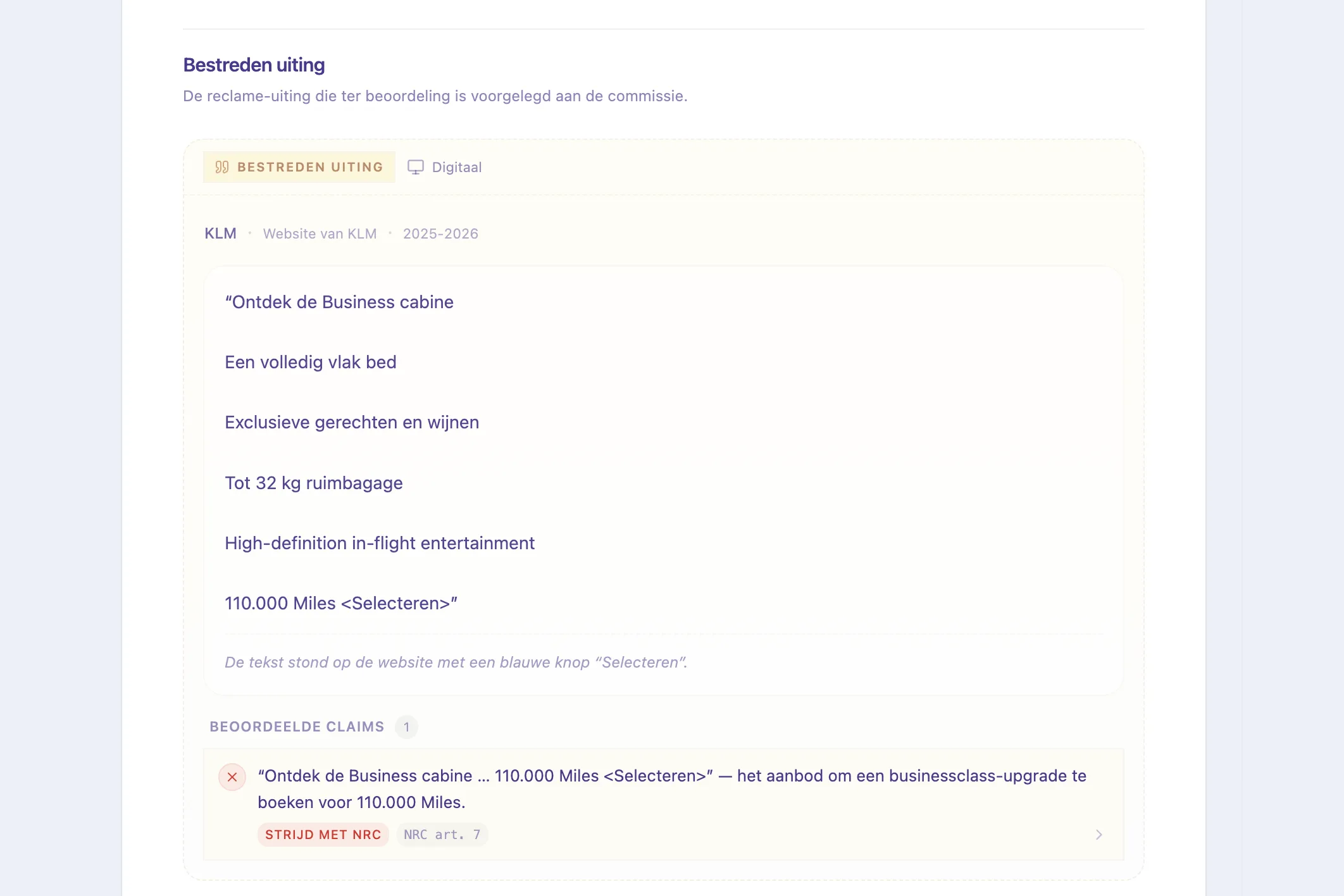
The advertisement itself at the top: the advertiser, the medium, the text as it ran on the site. Then the claims the committee assessed (Beoordeelde claims), each with its verdict and the article of the Dutch Advertising Code it breached: in conflict with NRC article 7. The earlier decisions the committee refers to and the news coverage follow.
Bouwarbitrage
Defect overview (Gebrekenkaart)
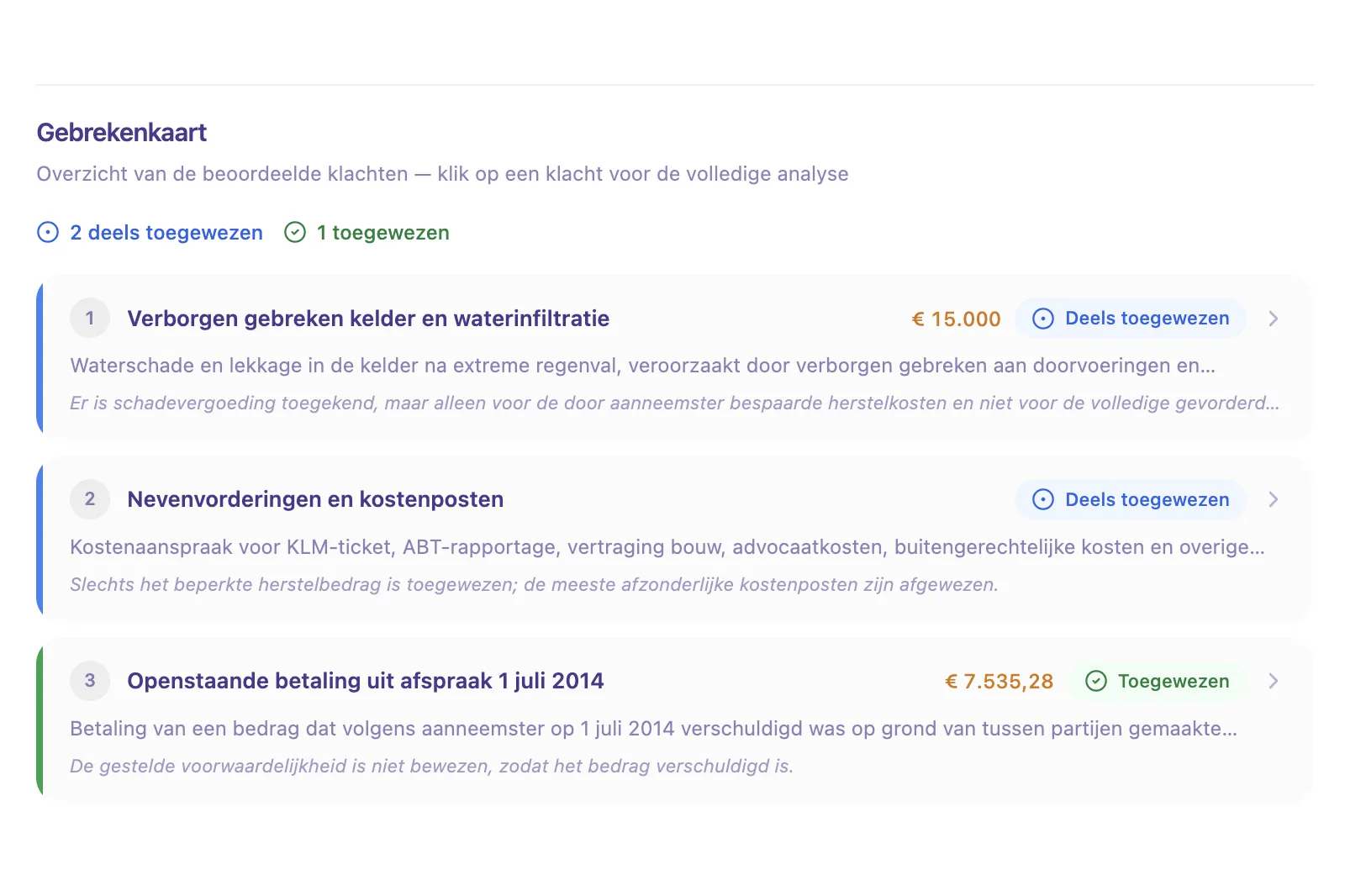
Every complaint the arbitrators assessed, numbered, with the amount awarded and the verdict: awarded (toegewezen), partly awarded (deels toegewezen), rejected (afgewezen). One line on why. Click a complaint for the full analysis. Warranty periods (garantietermijnen) show whether a warranty is still running or has expired.
Bouwarbitrage
Financial overview (Financieel overzicht)
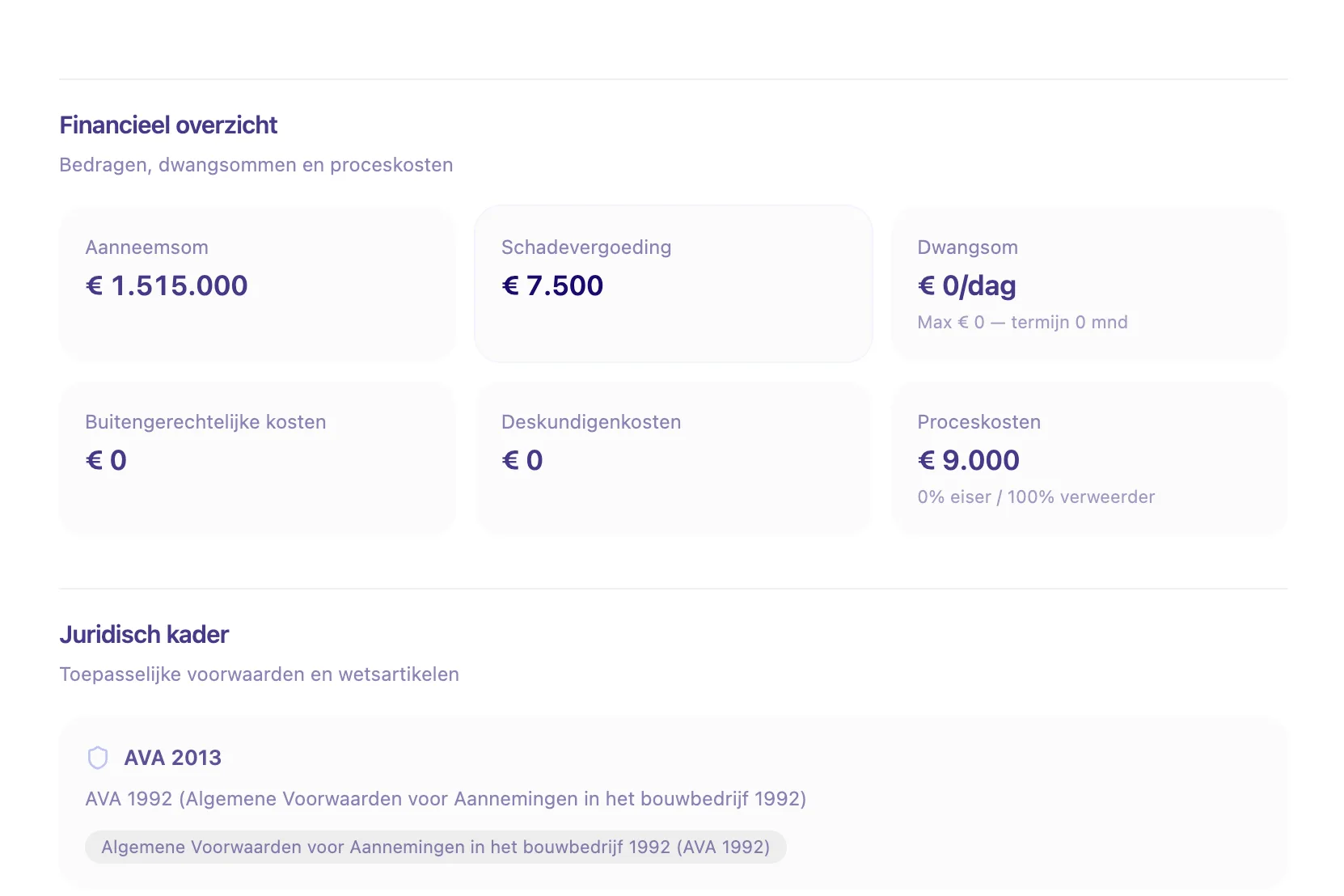
The contract sum (aanneemsom), damages, penalty payments (dwangsom), the costs of the proceedings with the split between claimant and respondent, expert costs and extrajudicial costs, on one card. The legal framework (Juridisch kader) lists the conditions that applied: UAV 2012, UAV-GC 2005, AVA 2013, Woningborg, and the Civil Code articles.
The development of a doctrine, on one line
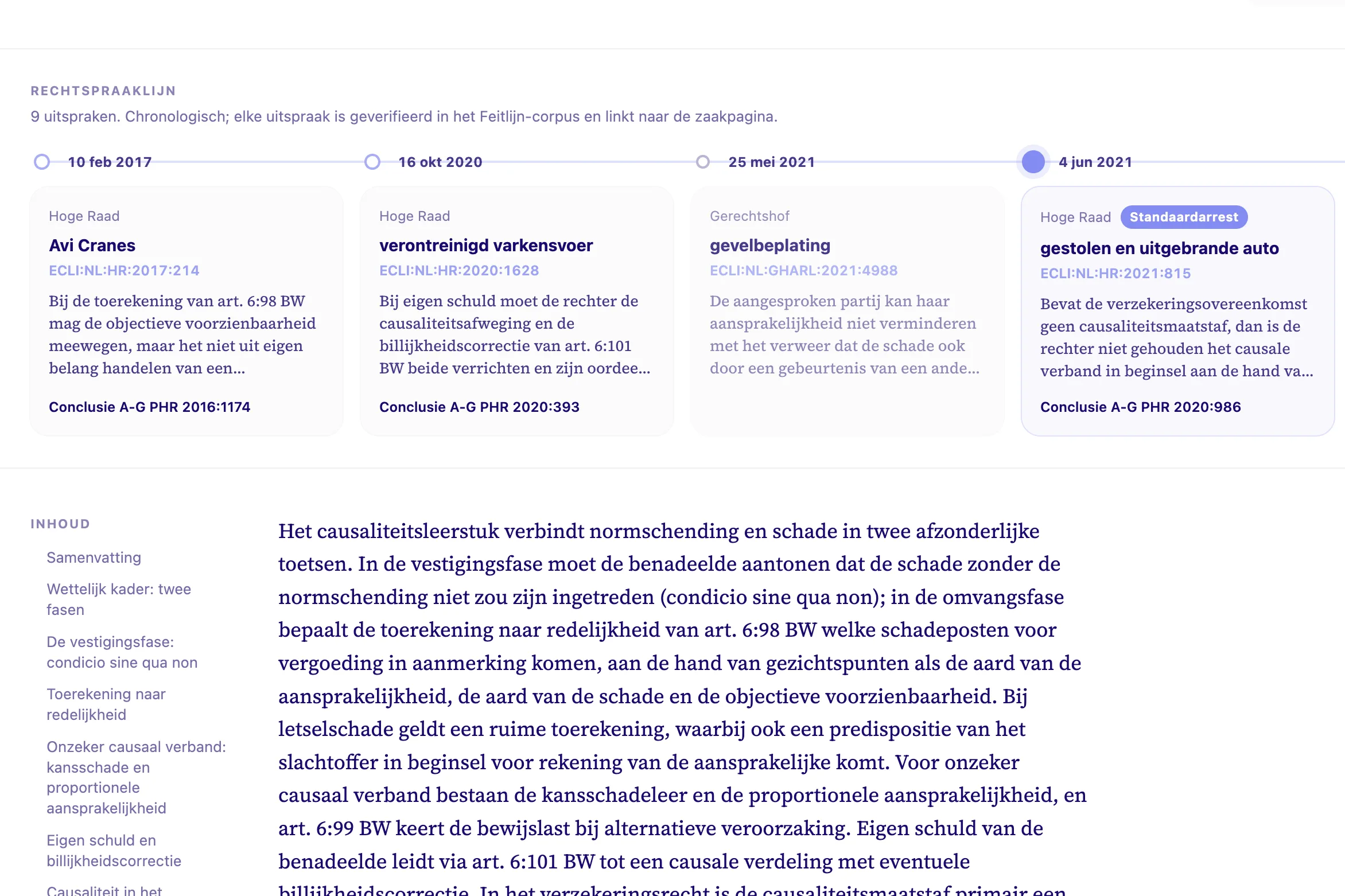
A doctrine page (leerstuk) gives the statutory framework (wettelijk kader), the core rules (kernregels) and the line of case law (rechtspraaklijn): the rulings that shaped the doctrine, in order, each verified in the Feitlijn corpus and linked to its case page. Landmark rulings (standaardarresten) are marked. The Advocate General's opinion sits under each ruling.
Open causation (causaliteit) and the line runs from Avi Cranes in 2017 through the contaminated pig feed case in 2020 to the stolen and burnt-out car in 2021. The lemma below it is written neutrally, for both sides.
From the ruling back to the doctrine
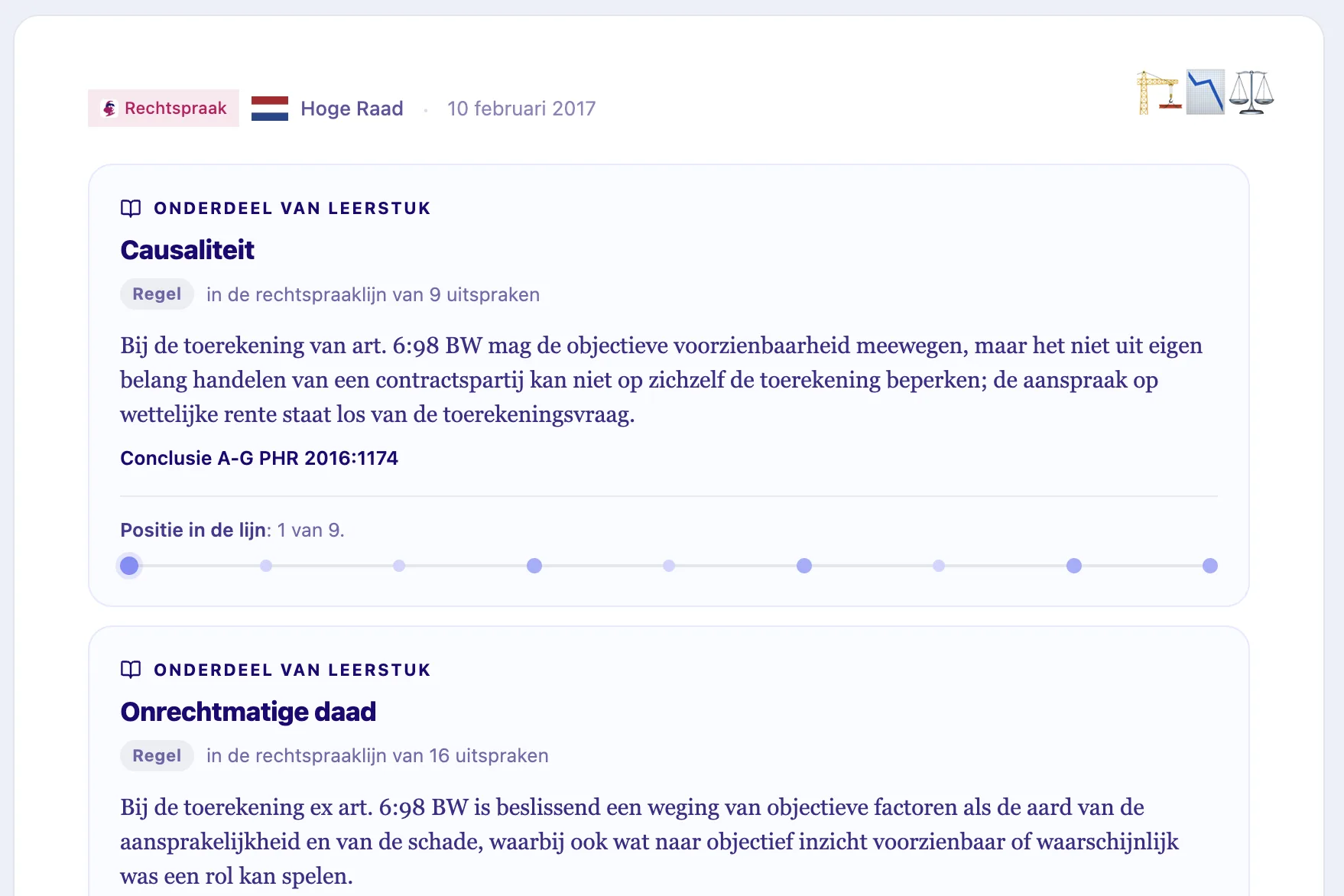
On the case page the relationship runs the other way. The block Onderdeel van leerstuk shows which doctrines a ruling belongs to, the rule it stands for in each, and its position in the line, with the earlier and later rulings a click away.
Sources are ECLIs and statutes only. Each lemma is written from the opinions of the Advocate General, the current statutory text and practice literature. No legal advice.
Ask the case. Ask the folder.
Every chat is grounded in the rulings in scope, with the answer pointing back to them. Part of Mino Pro.
One case
Chat over deze zaak
Chat about this case
Ask what the court decided on a specific point. Save the answer as a note on the case.
One aspect
Vraag over dit aspect
Ask about this aspect
Start from a timeline event, the issue, a ground for cassation or a preliminary question. The block you clicked is the context.
A folder or a collection
Chat over deze collectie
Chat about this collection
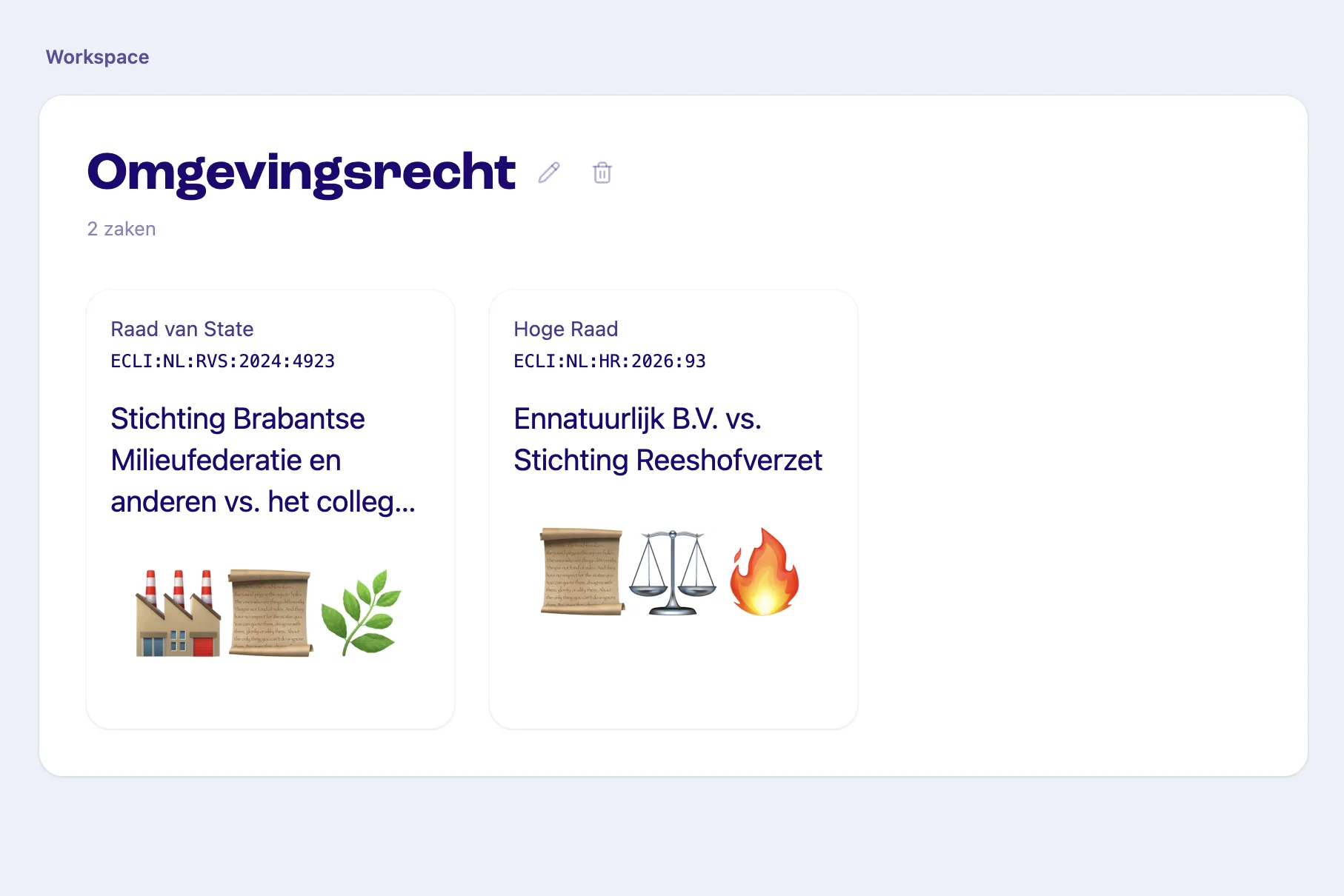
Group rulings in a folder and ask what they have in common, which considerations recur, where the line moved.
The case law your file already cites
A folder in Feitlijn is a matter in Mino. Upload the pleadings and Mino's document intelligence reads every ECLI they cite. Those rulings appear in the folder, marked as cited in a document in this folder (Genoemd in een document in deze map), with how often each one is cited.
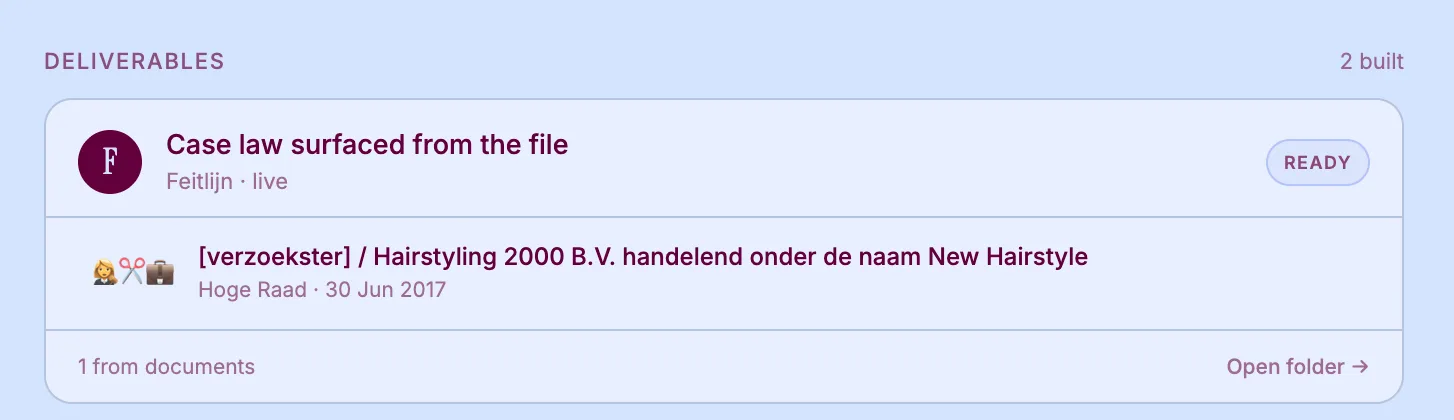
On the matter itself the same list is a deliverable: Case law surfaced from the file. Save any other ruling to the matter with Opslaan in map (save to folder) and it sits next to your documents, ready for Thea and Garry to use.
Curated by practitioners
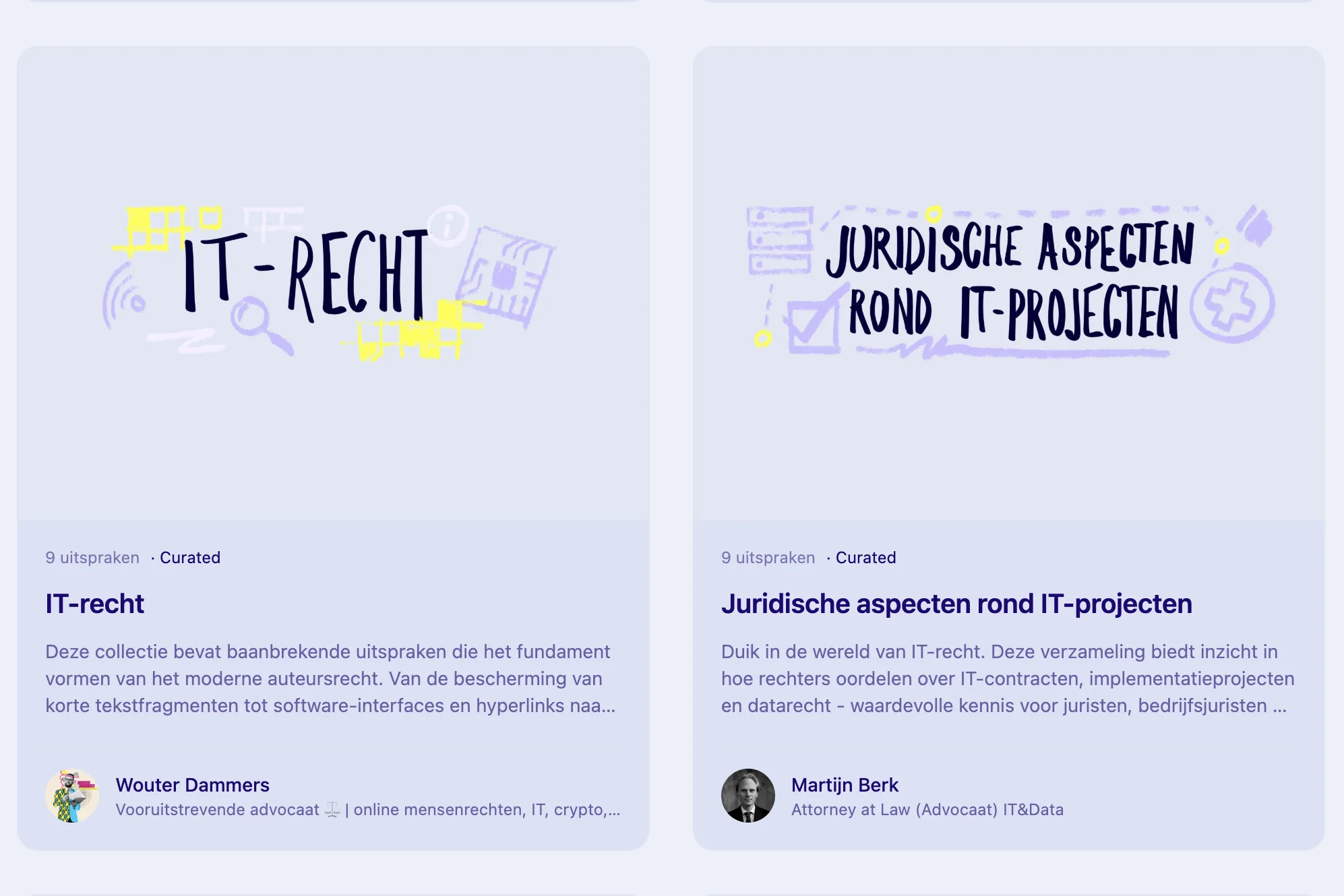
Collections (Collecties) are sets of rulings assembled by a legal expert on one theme, with a note per case: why it matters, what it changed. Chat with a collection, share it by link, or build your own from any folder.
Practice context (Praktijkcontext) shows which firms and blogs wrote about which rulings in the last 90 days, recent and trending. Tags by area of law and favourites in My Feitlijn (Mijn Feitlijn) keep your own reading in reach.
How lawyers use Feitlijn
Opposing counsel cites 15 rulings.
Paste each ECLI, or search the party name across all five sources. Every ruling opens as a structured case page: summary, IRAC, timeline. Decide in minutes which ones actually matter for your argument.
The full text only for the three that do.
A construction dispute lands on your desk, the first in years.
Search the Raad van Arbitrage awards on the defect type. The defect overview shows what arbitrators awarded and why, the financial overview shows the amounts, and the legal framework tells you which conditions applied.
You know the going rate before the first call with the client.
You need the line on causation for a pleading.
Open the doctrine page (leerstuk). The line of case law gives the rulings in order, the landmark ruling marked, the Advocate General's opinion under each. Save them to the matter and ask the folder chat which considerations recur.
A paragraph with verified ECLIs, not a search history.
European infrastructure
Feitlijn runs on European infrastructure. Your folders, notes and chat history stay in the EU.
Public sources only
Every analysis is built from published decisions and public law firm blogs. The source text is always one click away.
No training, ever
Your data is not used to train AI models. We use enterprise endpoints whose terms prohibit training on customer data.
Verified citations
Every ruling on a doctrine page is checked against the Feitlijn corpus before it is cited. Every analysis carries an AI notice.
Common questions
What is Feitlijn?
Feitlijn is Mino's case law research agent. It reads decisions from five public sources and turns each one into a structured analysis you can assess in minutes: summary, timeline, legal reasoning, statutes, and the blocks that matter for that kind of case.
Is Feitlijn only for Dutch lawyers?
Today, yes. The sources are the ones a Dutch practice works with, the analyses are written in Dutch, and the doctrine pages follow Dutch law. The European sources, Strasbourg and Luxembourg, are analysed for their effect on Dutch practice. An international edition covering other jurisdictions is in the works.
What sources does Feitlijn use?
Rechtspraak.nl for the Dutch courts, EUR-Lex for the Court of Justice and the General Court, HUDOC for the European Court of Human Rights, the Reclame Code Commissie (the Dutch Advertising Code Committee), and the Raad van Arbitrage in bouwgeschillen (construction arbitration). All of it is public. New sources are added as they are integrated.
What does a case page contain?
For a Dutch ruling: a summary (Samenvatting), a timeline (Tijdlijn), the legal analysis in IRAC (Juridische analyse), the statutes cited with their text (Wetsartikelen), the law firm blogs that discuss it, and the doctrine it belongs to. An Advocate General's opinion adds the grounds for cassation and the sources cited. A Court of Justice case adds the preliminary questions. A Strasbourg judgment gets a per-article analysis. An advertising code decision shows the contested advertisement and the assessment per claim. A construction award gets a defect overview and a financial overview.
How reliable are the AI analyses?
The analyses are generated by language models and reviewed by legal experts on an ongoing basis. Use them to decide what to read, not as a replacement for reading it. Every analysis ends with an AI notice, every ruling cited on a doctrine page is verified against the corpus, and the source text is always one click away.
Is there a free tier?
Yes. Search, case pages, doctrine pages and collections are free. Folders, favourites and notes need a free Mino account. Chat with a case, a collection or a folder is part of Mino Pro.
Five sources. One case page.
Search a party, an ECLI or a topic. The first case page is a click away, no account needed.
Free tier included. Chat with Mino Pro.


