Garry maps your arguments: structured dispute analysis for litigators


Upload your briefs. Garry maps both sides, matches the arguments, and shows you where the gaps are.
There is a specific moment in litigation that every litigator knows.
You have drafted your position. The legal theory is solid. You file feeling confident. Then six or twelve weeks later, their brief arrives. You read it. And for a moment, you think: I do not have a case.
Their arguments are sharper than you expected. They have reframed the facts. They have found the gap in your reasoning you did not see.
Then the mental work starts. You read it again. You make notes. You start mapping in your head: my argument, their argument, where do they overlap, where do they diverge. You read it a third time. Slowly, the structure of the dispute becomes clear. You realise you do have a case. You always did. You just could not see it until you could see the whole picture.
That process — the reading and rereading and mental mapping — takes hours. Sometimes days. Garry does it in a structured session.
What a legal position actually is
Before explaining how Garry works, it helps to understand what he is working with. A legal position in litigation is built in layers.
Both sides follow the same structure. Each side establishes the facts as they see them, identifies the legal rules that apply, and argues how those rules should be applied to those facts. The dispute lives in the differences between the two positions: different facts, different rules, or different application.
This is the structure Garry works with. Not a summary of your brief. Not a chat response. A structured map of where both positions agree, where they diverge, and where neither side has addressed the other.
How Garry works: four steps, each one reviewable
Garry is built around a four-step pipeline. Each step produces output you can review, refine, and steer before moving to the next.
1. Map your arguments
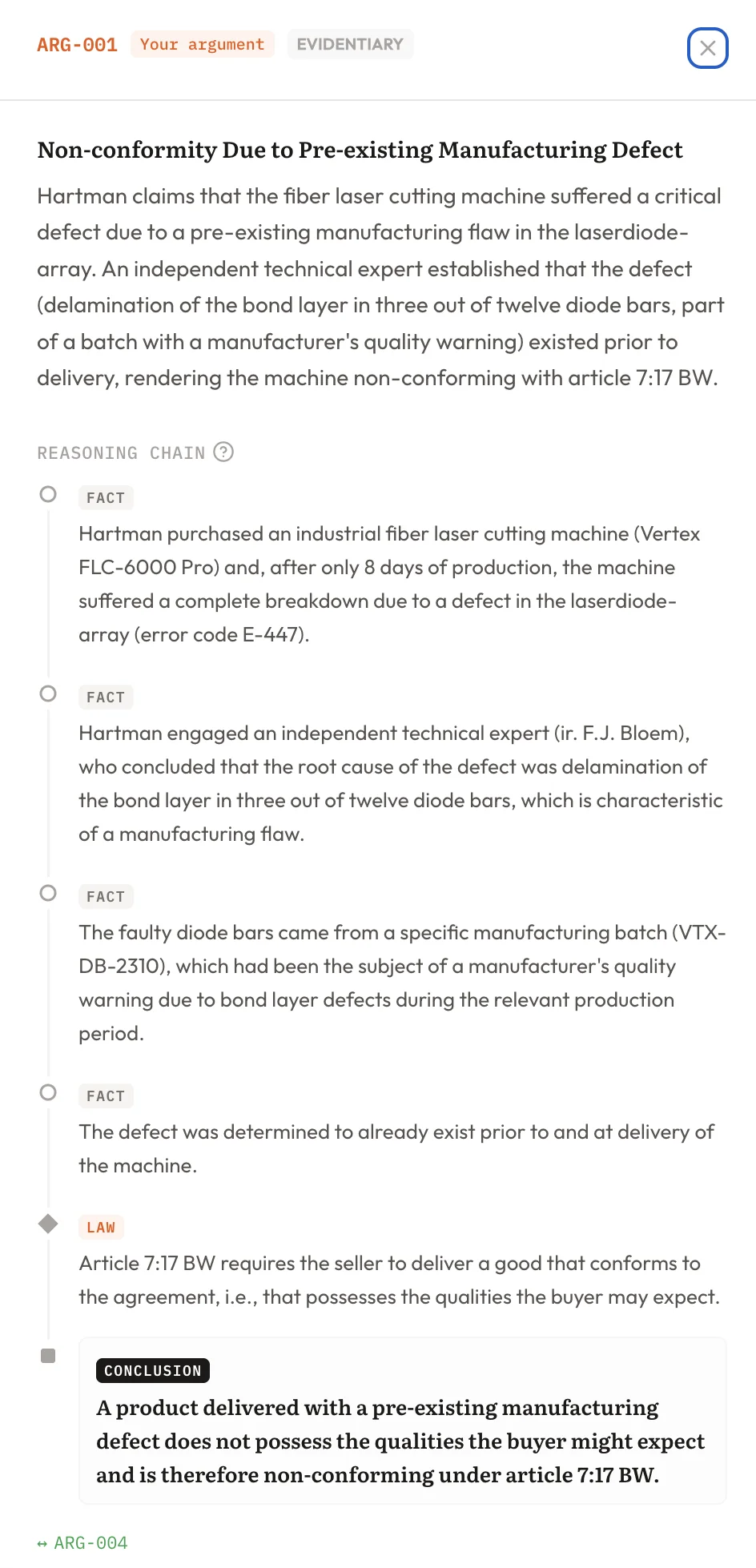
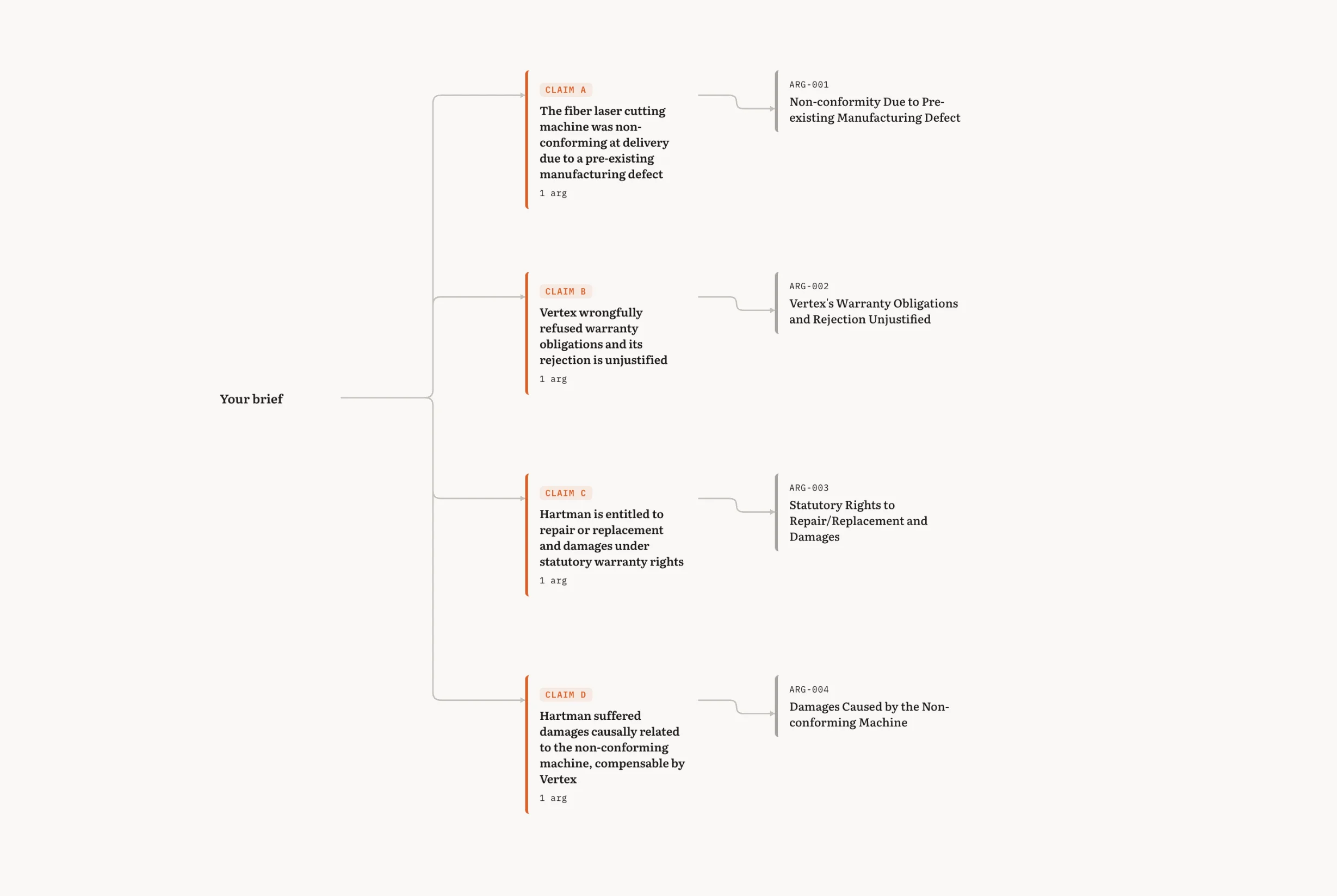
You upload your brief. Garry reads it and structures your claims, defences, and legal reasoning into a visual map. Before he moves on, you review and correct where needed.
2. Map their arguments
Same process for the opposing brief. Garry reads their position and maps it with the same structure, so both sides are comparable.
3. Match and compare
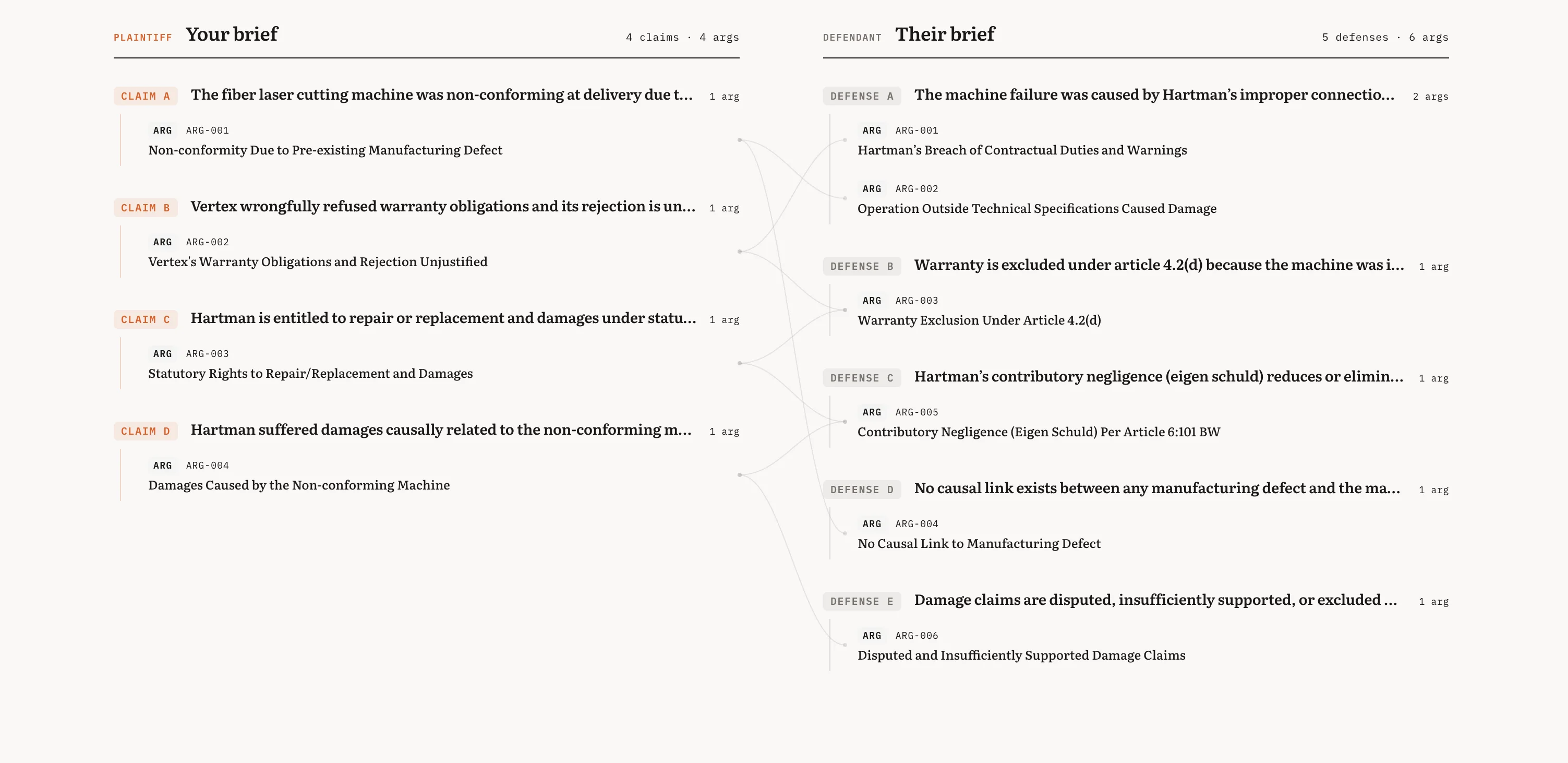
Garry overlays both maps. He matches which of their arguments respond to which of yours, and vice versa. Where there is a connection, you see a line. Where there is no line, there is silence — an argument that has gone unanswered.
4. Surface the gaps
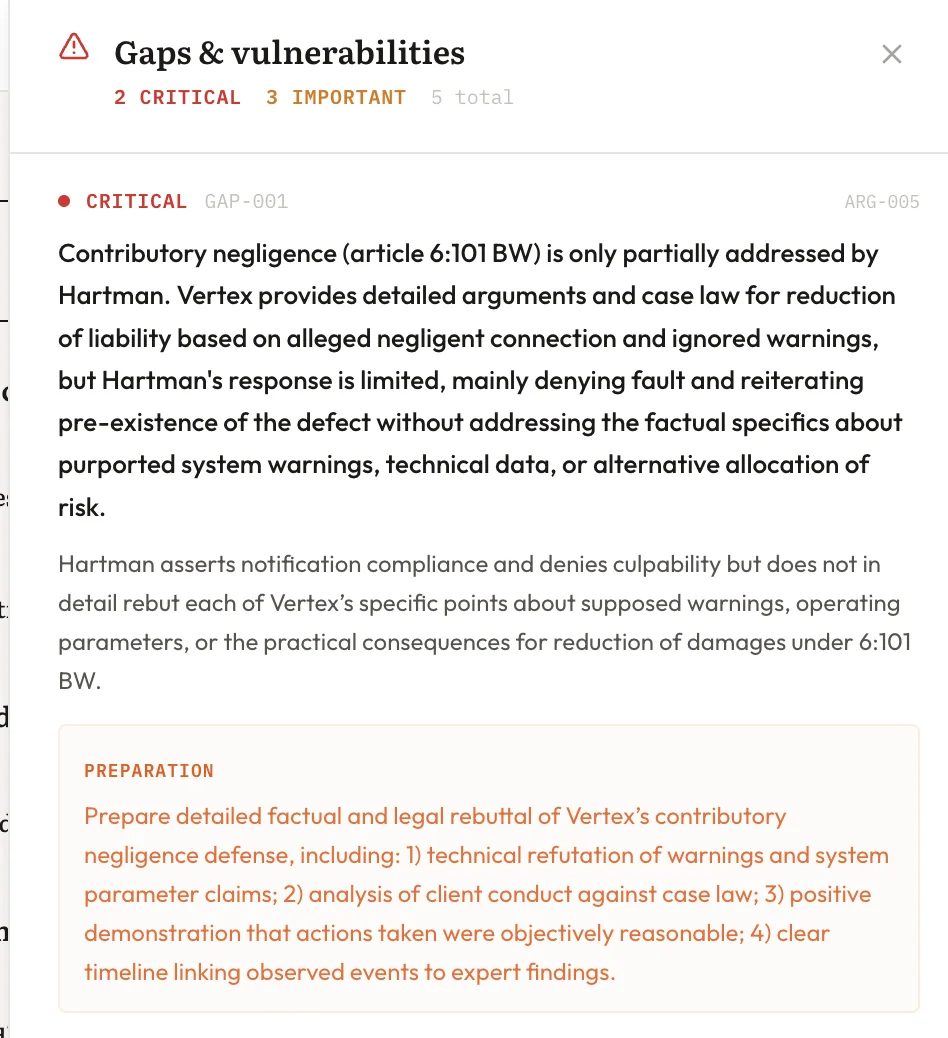
The final step makes the terrain of the dispute explicit. Which of your arguments have they ignored? Which of their points have you not addressed? What is still genuinely contested? This is the output that changes how you prepare.
Why four steps and not one click
When I was building this I kept asking myself: is this not too cumbersome? Four steps, with review moments in between, instead of one click.
At Patroon, we spent ten years mapping argument structures visually — for litigation teams, for client communication, for court submissions. Barbara Minto’s The Pyramid Principle gave us the theoretical framework: clarity comes from understanding the logical dependencies between ideas, not just listing them. You cannot shortcut your way to that clarity. You have to work through the structure.
If you practise in the Netherlands, you will recognise the logic. Dutch courts follow the civiel beslismodel — the structured decision framework described by Joke Halk — to work through the layers of a dispute: what is claimed, what is contested, what evidence supports each side. Garry follows the same structure. He maps arguments the way a court will read them.
The four-step pipeline applies the same idea. Each step forces you to engage with the material at a different level of abstraction. You are not just reading output. You are working with the content. And that process itself surfaces insights that a single-pass analysis would miss.
What the output looks like
Garry does not return a summary or a list of bullet points. The output is visual.
Arguments are nodes. Connections between arguments are lines. Where your argument meets their counterargument, there is a line. Where there is no line, there is a gap. The whole dispute is visible at once, structured like a map of the argumentative terrain.
The inspiration is metro maps. A metro map does not tell you everything about a city. It tells you how the parts connect, which routes exist, and where you need to change trains. Garry does the same thing for a legal dispute.
When to use Garry
Garry is built around real moments in a litigation matter, not abstract use cases.
Before filing: check your own reasoning. Upload your draft brief. Garry maps the argument structure and shows you where your reasoning has gaps or where claims are underdeveloped. Not a writing tool. A thinking tool.
When their brief arrives: map the full dispute. This is the core use case. Upload both briefs. Garry maps both sides, matches the arguments, and surfaces what is addressed and what is not. The hours of reading and rereading, compressed into one structured session.
Preparing for oral hearing: anticipate the hard questions. Once the gap analysis is complete, Garry generates the questions the court is likely to ask, based on the gaps he has identified. You can prepare your answers before walking in.
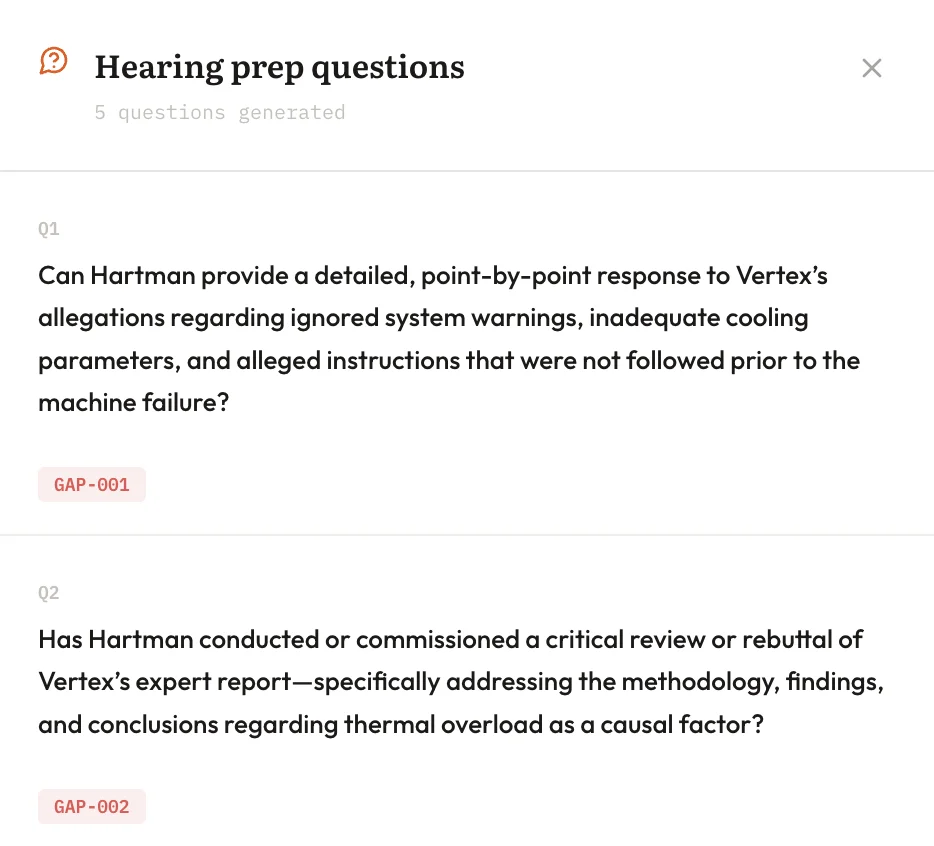
Two more scenarios are in development: uploading a judgment to compare against both briefs, and a comprehensive first-instance review for lawyers taking over a case on appeal.
Garry and Thea: facts layer and law layer
Thea handles the facts layer. She reads your raw source documents — emails, letters, WhatsApp messages — and builds the case timeline and party network.
Garry handles the law layer. He reads the briefs and maps the argument structure.
They work on the same case file. You upload once, and both agents work from the same documents. Thea gives you the factual foundation. Garry shows you what is being argued about it, and where the dispute is still open.
The facts layer and the law layer are different cognitive tasks. Mino gives you a specialist agent for each.
Garry is available now as part of a Mino Pro subscription.
Maurits Fornier is co-founder of Mino and founder of Patroon Legal Design. He spent five years as a litigator at Freshfields and ten years in legal design and technology. You can follow him on LinkedIn.


